No products in the basket.
Bioethanol fireplaces are a practical choice for customers who want a real flame without installing gas or bringing an unused chimney back into service. They are flexible, relatively straightforward to operate and available for both new and existing fireplaces.
They produce useful heat but are generally better suited to occasional use and supplementary heating rather than heating the whole home. As long as you have realistic expectations about the heat output and follow the supplied instructions, a bioethanol fireplace can create an attractive and welcoming focal point.
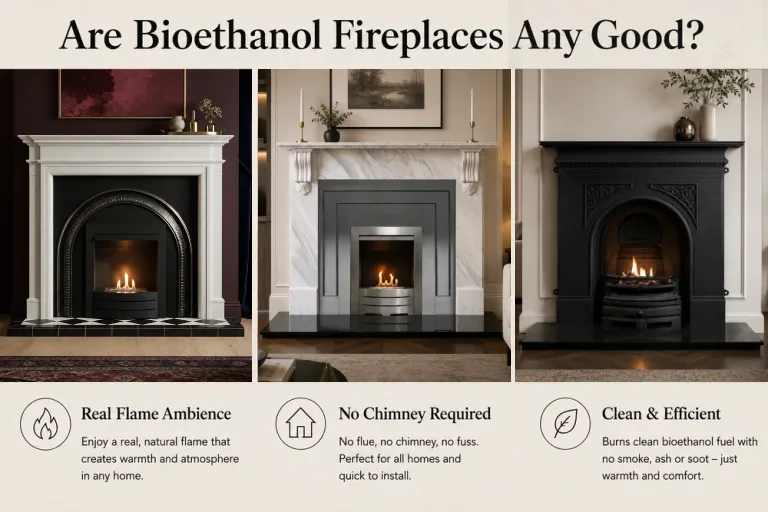
A bioethanol fireplace uses liquid bioethanol fuel held inside a purpose-made burner. The fuel is lit manually to create a real flame. There is no ash to clear, and most manual burners do not need an electrical connection, gas supply or working flue. The room must be suitably ventilated, and the fireplace should always be used according to the supplied instructions.
The main benefit is that you can enjoy a genuine flame in a room where a gas or solid-fuel fire may not be suitable. There are no logs to store, no ash to remove and no chimney sweeping required. Installation is also generally more straightforward because there is no gas connection or working flue to arrange.
Yes. Bioethanol fireplaces produce heat as well as a visible flame. The amount depends on the size and design of the burner. Larger burners generally create a broader flame and more heat, but they may also use fuel more quickly. Check the heat output shown on the individual product page before ordering. Bioethanol is normally best used as a supplementary heat source alongside your main heating system.
Burning time varies between products. Smaller burners generally use fuel more slowly, while larger burners create a wider flame and may use it more quickly. Burn time can also be affected by how far the burner opening is adjusted. The fuel capacity and expected burning time are shown on each product page. Always follow the stated filling level and never overfill the burner.
Running costs depend on the price of bioethanol fuel and how quickly the burner uses it. You can estimate the hourly cost by dividing the price per litre by the expected burning time per litre. A smaller burner may cost less per hour, while a larger burner may provide a broader flame and greater heat output. Check the individual specifications before comparing different fires. Bioethanol may not be the cheapest option for heating a room for long periods every day. It is mainly chosen for its real flame, flexible installation and ease of use.
Most manual bioethanol fireplaces do not need a working chimney, flue or electrical connection. This makes them useful for properties where the chimney has been blocked, removed or is no longer in use. However, some traditional cast iron fireplaces still need a suitable recess behind the insert because of their depth. For rooms without an opening, a purpose-designed flat-wall package may be more suitable. Always check the fitting requirements shown on the individual product page.
The right option depends on what is already in your room.
A complete bioethanol fireplace package is suitable when you need the surround, fire and hearth. Our range includes traditional packages, contemporary suites and flat-wall options.
A bioethanol conversion kit is designed for customers who already have a suitable fireplace, grate or stove. Conversion options include round, small and large burners, dedicated burners for selected Gallery fireplaces and a 16-inch inset bioethanol fire.
Bioethanol fireplaces generally require less specialist work than gas or solid-fuel fires because there is no gas connection or working flue. However, complete fireplace packages must still be assembled and secured correctly. Stone surrounds, cast iron inserts and hearths are heavy, and some designs require a suitable recess. Flat-wall packages are made for rooms without a traditional fireplace opening, but the wall and fitting requirements must still be checked before installation.
Bioethanol fuel must be purchased and stored safely, and the burner needs to cool fully before it can be refilled. A bioethanol fire also requires more manual operation than an electric fire, which can normally be switched on and off instantly. You should also consider the running cost if you plan to use the fire for several hours every day. Bioethanol is usually chosen for its appearance and occasional heat rather than as the main heating source for a property.
Phone
01773 718718
Email
sales@castfireplaces.co.uk