No products in the basket.
If you don’t have a working chimney, two of the easiest ways to add a fireplace to a room are bioethanol and electric. Both can work particularly well in modern homes and on flat walls, and both can be used to create a proper fireplace rather than simply adding a fire to the room.
The main difference comes down to what you value most: bioethanol gives you a genuine flame, while electric gives you convenience at the touch of a button. Neither is necessarily better than the other.
For me, the choice comes down to how important that real flame is to you, and whether you’re happy to give up some of the convenience you get with an electric fire. So, which should you choose?
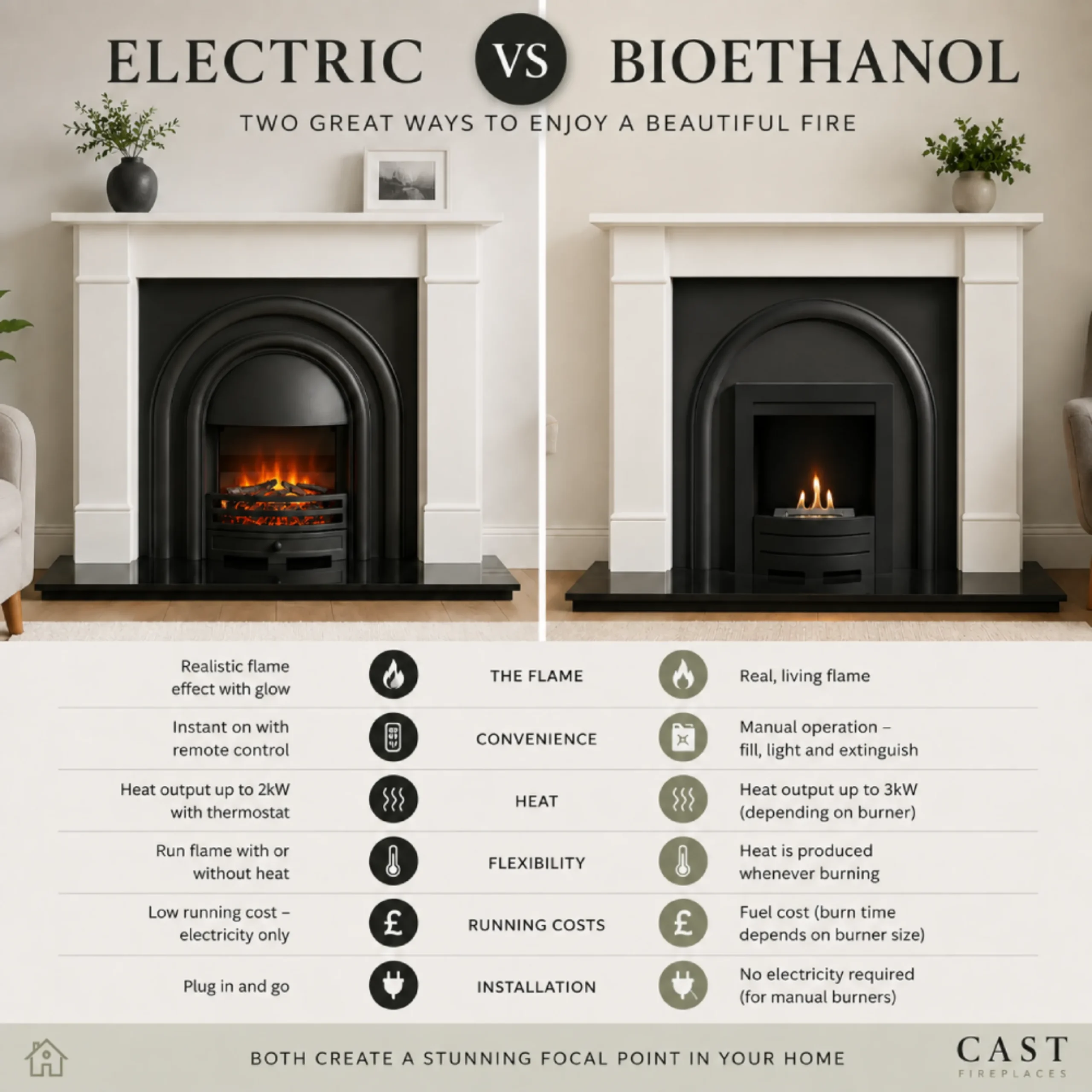
The biggest difference is the flame itself. A bioethanol fireplace burns liquid bioethanol fuel, so the flame you see is a genuine living flame, whereas an electric fire recreates the appearance of a fire using flame-effect technology.
Modern electric fires have improved considerably and there are now some very realistic effects available, but ultimately you are still looking at a simulated flame. If you have always wanted the movement and character of a genuine flame, bioethanol has a clear attraction; if you’re more interested in creating the appearance and atmosphere of a fireplace and value simplicity, a good electric fire can be an excellent choice.
If we are talking purely about having a real flame, bioethanol has the advantage because it actually is one. That doesn’t mean modern electric fires should be dismissed. Electric flame technology has moved on enormously.
LED effects can create a very convincing fire, while some higher-spec electric models now use LCD technology to create considerably more detailed flame displays. The fuel bed makes a difference too. Realistic logs, lighting beneath the fuel bed and adjustable flame settings can make a good electric fire look very convincing. It’s one of those things I would always recommend seeing in person if possible, because photographs and videos don’t always show either type of fire at its best.
This is where electric has a definite advantage. An electric fireplace can normally be switched on and off using a remote control. You can sit down, turn the flame on and enjoy the fireplace without having to prepare or light anything. Many electric fires also allow you to use the flame effect without the heater, so you can have the appearance of a fire even when you don’t need additional warmth.
Bioethanol involves a little more effort. The burner needs to be filled with fuel and lit manually, and when the fuel has been used you need to allow the burner to cool before refilling it. It isn’t difficult, but it isn’t as convenient as pressing a button on a remote control.
Both can provide useful additional heat, but they do it differently. Many of the electric fires we use in our fireplace packages have thermostatically controlled heaters with settings up to around 2kW. The bioethanol burners used in some of our fireplace packages can produce up to around 3kW, depending on the burner and how it is being operated.
There is also a difference in how you use the heat. With electric, the heater can normally be switched on or off independently of the flame effect. That means you don’t have to produce heat every time you want the fireplace on. A bioethanol flame naturally produces heat whenever it is burning.
For either option, I would regard the fire primarily as supplementary room heating rather than choosing it as the main heating system for the home.
This is slightly more complicated because you aren’t comparing like for like.
With an electric fire, you can use the flame effect by itself for relatively little electricity and only switch the heater on when you actually want heat. At the time of writing (August 2026), an electricity rate of around 26p per kWh means that a 2kW electric heater running continuously at full power would cost approximately 52p per hour. Actual cost will depend on your electricity tariff, the heat setting and how often the thermostat turns the heater on and off.
Bioethanol running costs depend on the burner and how far it is opened. At the time of writing (August 2026), our bioethanol fuel works out at around £2.85 per litre. At that fuel price, our larger bioethanol burner burns for approximately 3.5 hours per litre when fully open, which works out at around 81p per hour. Our smaller burner burns for approximately 5 hours per litre when fully open, which works out at around 57p per hour. The smaller burner has an 800ml capacity, so a full container costs around £2.28 to fill and gives approximately 4 hours of burning time when fully open.
These figures are intended as a guide, as electricity tariffs and bioethanol fuel prices can change. If running cost and frequent everyday use are important considerations, electric is likely to have the advantage. Bioethanol generally costs more to run, but its main attraction is the genuine flame.
For our flat-wall fireplace packages, installation can be quite similar. Both electric and bioethanol options can be incorporated into a complete fireplace package designed to sit against a suitable flat wall without needing a conventional working chimney. The fireplace components still need to be correctly assembled and secured, but you aren’t necessarily faced with the building work associated with installing a traditional working fire. With an electric fireplace, you will need a suitable electrical supply. Ideally, the socket needs to be planned so that plugs and cables don’t spoil the finished appearance.
Bioethanol doesn’t require an electrical connection for a manual burner, which can give you more freedom in some rooms. The exact fitting requirements will depend on the fireplace and fire you choose, so always check the individual product before ordering.
Yes, and this is worth thinking about before choosing purely on the flame effect. Some electric fires are specifically designed to work within shallow flat-wall fireplace packages. Higher-spec electric fires, particularly some larger or deeper LCD models, can require considerably more depth. These may need a purpose-built recess, false chimney breast or another form of structure around the fire rather than simply fitting into a shallow flat-wall fireplace. This isn’t necessarily a disadvantage.
If you want a very contemporary room, it opens up another option altogether: a media wall. A media wall allows you to use a much wider electric fire and incorporate it into the architecture of the room, often with a television above and storage or shelving around it. So electric gives you a particularly wide choice, from traditional fireplace suites through to large contemporary media-wall fires.
I don’t think the fuel type should dictate the quality of the fireplace. You can create an attractive traditional-style fireplace with either. We offer electric and bioethanol fireplace packages using materials such as marble, limestone, cast iron and wood, so you’re not limited to an inexpensive flat-pack suite just because you don’t have a working chimney. The surround, hearth and insert have a huge effect on the overall appearance.
A marble fireplace with an electric fire can still look like a substantial, high-quality fireplace. Likewise, a traditional bioethanol package can create a similar overall look while giving you a genuine flame. I’d choose the fireplace you actually want in the room first, then consider which fuel option works best with the way you intend to use it.
Both are very good options.
If you have no chimney breast and simply have a flat wall, there are complete fireplace packages designed specifically for this situation. With bioethanol, you can create the appearance of a traditional fireplace while still having a genuine flame. With electric, you can achieve a very similar overall fireplace appearance with the added convenience of remote control and instant operation.
The choice comes down more to how you want to use the fireplace than whether you have a chimney.
It genuinely depends on what matters most to you.
If I wanted a fireplace primarily for convenience, used it regularly and liked being able to switch the flame on from the sofa without producing heat every time, I would choose electric. Modern electric fires are very good and there are considerably more flame effects, fuel beds and fireplace styles available than there used to be.
If the thing I really wanted was a genuine flame, I would choose bioethanol. You have to accept that it involves filling and lighting the burner and that it isn’t quite as convenient as electric, but in return you get a living flame.
That’s really the decision I would make:
How much do you value having a real flame, and is it worth giving up some of the convenience of electric to have one?
There isn’t a wrong answer.
If you’re undecided, seeing the two types of fire operating is probably the best way to choose. We have working bioethanol fires on display in our Heanor showroom, alongside electric fires including the SLE40i and SLE43 ranges with a choice of different frames. This gives you the chance to compare a bioethanol flame with a modern electric flame effect rather than making the decision from photographs alone. You may be surprised by how good modern electric fires look, or you may see the bioethanol flame and decide that having a real flame matters more to you.
If the real flame is what appeals to you most, have a look through our complete bioethanol fireplaces.
If convenience and modern electric flame effects suit you better, browse our electric fireplace suites and if you prefer a larger, more contemporary built-in fire, you can also explore our electric media wall fires.
Both can create an excellent fireplace. The right one is simply the one that suits how you want your fireplace to look and how you want to use it.
Phone
01773 718718
Email
sales@castfireplaces.co.uk