No products in the basket.
Choosing a fireplace isn’t just about whether you live in an old cottage, Victorian terrace or modern new build. The size of the room, chimney breast and how you want to use the fire are just as important.
At Cast Fireplaces, we’ve supplied fireplaces and stoves for all sorts of properties over the years. Here are some of the combinations we’d choose for different types of home, based on our own experience and what customers regularly buy from us.
My own house is around 300 years old, and I’ve chosen a Parkray Aspect 5 stove fitted into a brick-built fireplace chamber with a solid oak beam above. It’s a modern-looking stove with a large glass window, but I think it works really well against the old brickwork and oak. You don’t always need a traditional-looking stove just because you live in an old property. Sometimes the contrast between a contemporary stove and original features works better, and that’s certainly my preference.
Victorian terraces can be quite different depending on the size of the rooms and chimney breasts. For a smaller dining room, I’d often choose a cast iron fireplace. These have the fireplace and mantel shelf as one casting, so there’s no need for a separate surround. They’re particularly useful where space is limited. For the main living room, I’d usually go for something a little larger. A traditional arched cast iron insert paired with a limestone, marble or wooden surround works well in this type of property.
The main thing is getting the proportions right. A fireplace that’s too large for the chimney breast can look out of place, even if it’s the right period style.
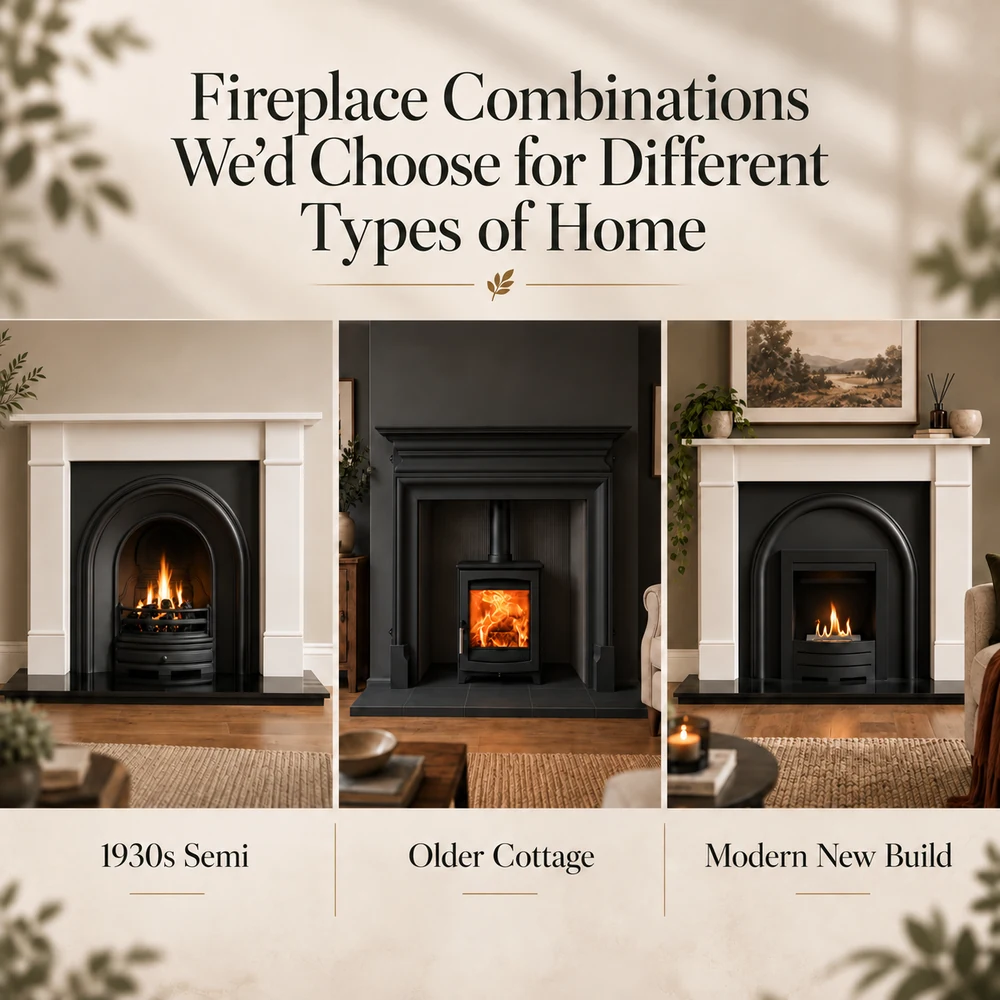
Many modern new builds don’t have a traditional chimney, which is why our flat-wall fireplace packages would be my first choice for customers wanting a traditional-looking fireplace. These are available with electric or bioethanol fires, so you can have a proper fireplace surround and hearth without needing an existing chimney.
We also supply wood-burning stoves for modern properties, sometimes using a twin-wall flue system. This allows a suitable stove to be installed where there’s no conventional chimney, provided the installation meets the relevant requirements.
Freestanding electric and bioethanol stoves are also becoming more popular, particularly where customers want the appearance of a stove without installing a conventional flue.
For a typical 1930s semi, I’d look at two quite different options.
If the customer wants a stove for heating, there’s a wide choice of wood-burning and multi-fuel stoves to suit different budgets and styles. These can be fitted into a fireplace opening with a simple oak beam or paired with a cast iron, limestone or marble surround. The choice depends on the size of the fireplace opening, the heat output needed and the look the customer wants.
For customers who don’t want a stove, one of our most popular combinations is the Crown and Brompton Limestone Fireplace.
This pairs a traditional arched cast iron insert with an Aegean limestone surround. It’s a combination we’ve supplied for years and one that works particularly well in this type of property.
In a larger country home, there’s often more room to work with, particularly if the property has a wide chimney breast. I’d look at a bigger stove paired with a substantial limestone or marble surround. A wide mantel helps balance the proportions of the room and gives the stove a proper setting. Traditional cast iron inserts are another option, especially when paired with a larger decorative surround. For these types of rooms, we’d often be looking at surrounds around 54 inches wide or larger, depending on the chimney breast and fireplace opening.
It’s still important to choose a stove with the right heat output for the room rather than simply buying the biggest model available.
These are combinations we’d happily recommend, but there isn’t one fireplace style that suits every property. I’d always start with the size of the chimney breast, the available space and whether you want the fire mainly for heating or appearance. Budget and personal taste will also play a part.
If you’re unsure what would work in your home, send us a photograph of your existing fireplace or chimney breast along with a few measurements. We’re happy to suggest suitable combinations from our range.
Phone
01773 718718
Email
sales@castfireplaces.co.uk