No products in the basket.
If you already have a fireplace, replacing the existing fire can be one of the simplest ways to give it a completely different appearance. But choosing an inset electric fire isn’t simply a case of finding one you like and ordering it. The opening needs to be suitable, the depth needs to work and the style of the fire needs to suit the fireplace around it. This is where I’d start.
If you’re ready to compare the fires themselves, take a look at our Inset Electric Fires.
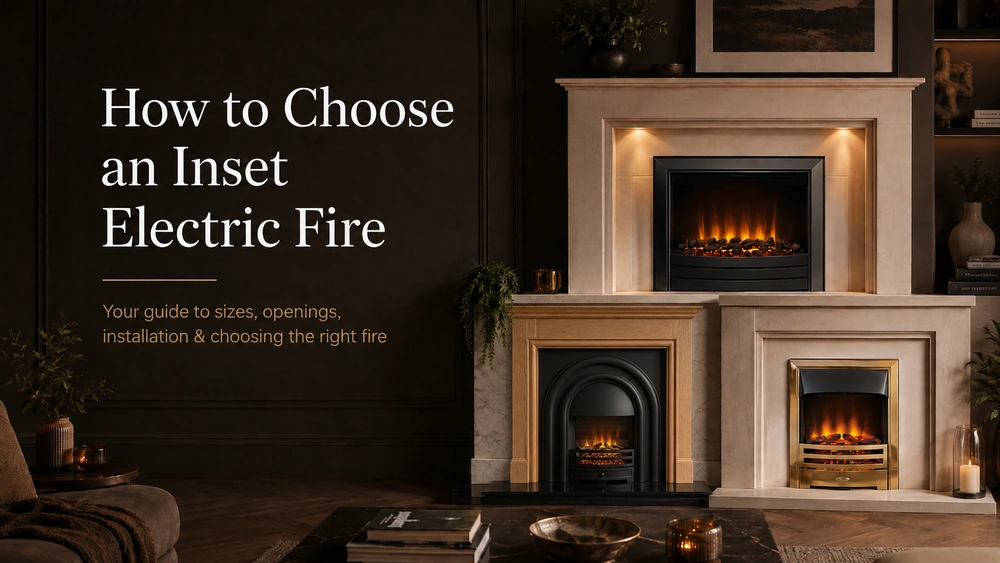
An inset electric fire is designed to sit within a fireplace opening rather than standing out into the room like a freestanding electric stove. They’re particularly useful when you already have a fireplace and want to replace an older fire without changing the complete surround. They can also be used as part of a new fireplace where you want the fire to sit neatly within the design.
Before choosing the fire, I’d measure the opening.
The main measurements you’ll need are:
If the opening isn’t completely square or there are any unusual shapes, rebates or projections, it’s worth noting those too. If you’re replacing an existing electric fire, take the dimensions of that as well and make a note of the make and model if you still have it.
Inset electric fires can look quite similar from the front, but their overall dimensions aren’t necessarily the same, and even a relatively small difference in width or depth can matter when you’re working with an existing opening. That’s why I wouldn’t choose a replacement based purely on the visible fascia — check the complete dimensions and installation requirements for the exact model you’re considering.
If you’re unsure, send us:
It’s much easier for us to check compatibility at the start than to discover the fire doesn’t fit once it arrives.
Finding a fire that fits is only part of the decision. The surrounding fireplace has a big effect on how the finished fire looks. A traditional cast-iron fireplace, marble mantel or decorative surround can work particularly well with a traditional trim or fret. A simple black or contemporary fascia can give the same type of inset fire a much cleaner appearance.
This is one of the things we like about inset fires. They aren’t restricted to one style of fireplace. I’d look at the fire and surround together rather than choosing each part in isolation. The aim isn’t just to find a fire that fits. It should look like it belongs in the fireplace too.
The fuel bed can change the finished appearance more than you might expect. A coal effect often works particularly well in more traditional fireplace settings. A log effect gives you a different look and can suit both traditional and more contemporary fireplaces depending on the surrounding design.
We have both running in our showroom, and it’s much easier to see the difference when the fires are installed within complete fireplaces rather than photographed on their own.
An electric fire doesn’t require a working chimney or flue. That doesn’t mean every inset fire can simply be placed into every fireplace opening, though. The individual model will still have its own dimensions and installation requirements, so these need to be checked before fitting. If an existing gas or solid-fuel appliance is being removed, any work relating to that appliance also needs to be dealt with correctly before the electric fire is installed.
This is one area where seeing the fire in a finished fireplace is particularly useful. At Cast Fireplaces, we have several Solution inset fires running in different settings.
Our SLE35i is installed in a fully polished Pembroke cast, which shows how a modern inset electric fire can work within a very traditional fireplace.
We also have an SLE40 with a Provident cast-iron frame and log effect, alongside more contemporary SLE40i, SLE43i and SLE55i fascia options.
Seeing them running gives you a much better idea of how the fascia, fuel bed and surrounding fireplace change the finished appearance.
If you’d like to know more about the flame technology, controls and wider range, take a look at our Solution Electric Fires page.
Before choosing an inset electric fire, I’d check:
If you don’t already have a suitable fireplace or would rather choose the fire and surround together, take a look at our Electric Fireplace Suites.
Phone
01773 718718
Email
sales@castfireplaces.co.uk