No products in the basket.
If you have a fireplace you still like but the gas or electric fire in the middle is starting to look dated, you don’t necessarily need to replace the whole thing. In many modern fireplace suites, the surround, hearth and back panel can stay where they are. If the existing fire sits within a standard inset opening, you may be able to remove it and replace it with a 16-inch inset bioethanol fire.
For me, that’s one of the main attractions of this type of fireplace makeover. You keep the fireplace you already like and simply change what’s happening in the middle — this time with a genuine flame.
Quite often, yes. We see plenty of limestone, marble and wooden fireplace suites where the surround itself is still perfectly good, but the customer simply wants to change the fire in the middle.
The main change is the fire in the centre. That can make it a much simpler and less expensive way of updating the fireplace than replacing the complete suite.
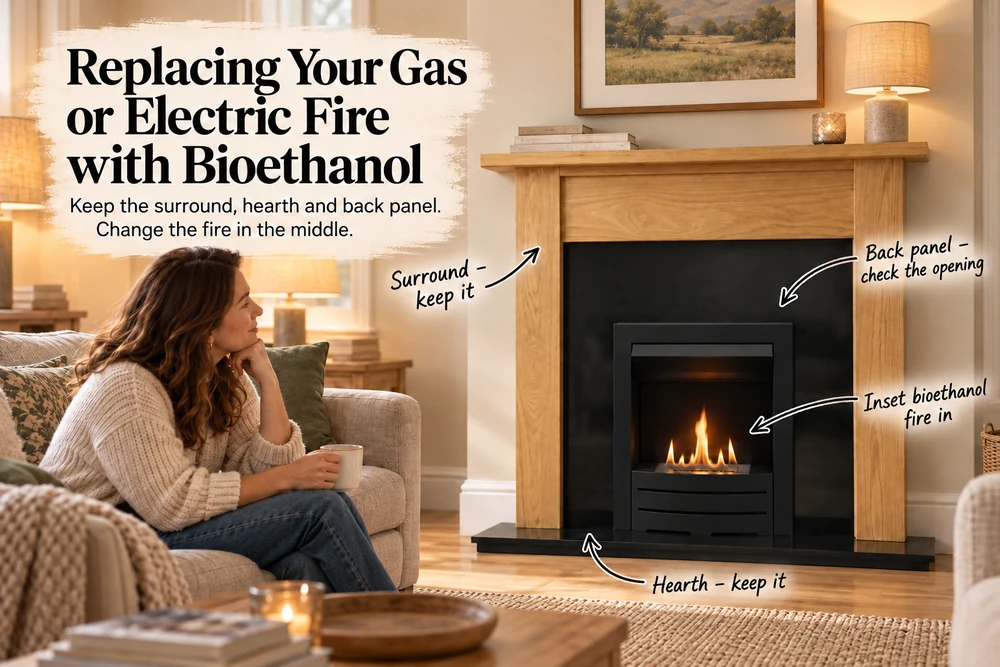
A lot of modern fireplace suites use a back panel with an opening approximately 16 inches wide by 22 inches high. This is the opening in the back panel that the inset fire fits into. The term 16-inch fire refers to the standard type of inset fire designed for this kind of opening — it doesn’t mean the complete fire is only 16 inches in every dimension.
Gas and electric inset fires have been fitted into this style of opening for years, which is where our 16-inch inset bioethanol fire can be particularly useful. If that’s what you already have, replacing the fire may be possible without changing the surround, hearth or back panel.
You will still need to check the opening dimensions and available depth against the fire itself.
Bioethanol fires are unflued, so the room also needs adequate ventilation.
If you’re unsure, send us a photograph of your fireplace along with a few basic measurements and we can help you work out whether the inset bioethanol fire is suitable.
Changing from gas has one important additional step. The existing gas fire needs to be removed and the gas supply safely capped off by a suitably qualified Gas Safe registered engineer. Once that’s been done, you can look at replacing the old fire with the bioethanol version.
It isn’t simply a case of pulling the gas fire out and putting another fire in its place, but you shouldn’t need to replace a perfectly good fireplace just because you’re moving away from gas.
Changing from an inset electric fire is generally more straightforward because there’s no gas supply to remove. If it sits within a standard inset opening, the main job is checking that the dimensions work with the replacement bioethanol fire. You can then keep the existing surround, hearth and back panel while changing the fire in the centre.
There’s nothing wrong with replacing an older electric fire with a newer electric model. For plenty of customers, that will still be the right choice. Bioethanol becomes interesting when having a real flame matters to you. An electric fire recreates the appearance of a flame, whereas bioethanol gives you a genuine live flame.
That can work particularly well in limestone, marble and other traditional-style fireplace suites where you like everything about the fireplace but want something more natural in the centre. For most customers considering this particular change, that’s really the attraction.
Traditional fireplaces are slightly different. A cast iron insert, Victorian fireplace, open grate or similar fireplace isn’t the same setup as a modern back panel with a standard 16″ x 22″ inset opening. In that situation, we would normally look at a bioethanol conversion burner or one of our dedicated conversion kits rather than the 16-inch inset fire.
Our guide, How to Convert an Existing Fireplace to Bioethanol, covers measuring and choosing the appropriate conversion option in more detail.
If your surround, hearth and back panel are still in good condition, don’t assume you need to start again just because you no longer want the gas or electric fire in the middle. For a modern fireplace with a standard inset opening, a 16-inch bioethanol fire can be a straightforward way of updating it and adding a genuine flame.
For an older cast iron or open fireplace, a conversion burner or kit will usually be the better route. Either way, you’re not automatically committing to the cost and disruption of replacing everything.
The starting point should always be the fireplace you already have.
Browse our Bioethanol Conversion Kits to compare the 16-inch inset fire with the traditional conversion options, or send us a photograph and a few measurements and we’ll point you in the right direction.
Phone
01773 718718
Email
sales@castfireplaces.co.uk