No products in the basket.
When customers are choosing a stove, one of the first decisions is often whether they want something traditional or more contemporary.
Some people know immediately. If somebody has their heart set on a traditional stove, I find they very rarely change their mind when they see one of the cleaner, modern designs in the showroom. But I don’t think the age of the property should dictate which style you choose.
My own house is around 300 years old and I have a Parkray Aspect 5. In fact, I have used the same style of stove in two very different settings — one in an exposed brick-built chimney and another in a much simpler plastered fireplace.
Both are contemporary-looking stoves in an old property, and that is exactly the look I prefer.
There isn’t one feature that makes a stove traditional, but you normally see more detail in the design. Two-door stoves are a good example. The Hunter Herald range is the sort of stove I immediately think of when somebody says they want a traditional look.
You also tend to see things such as:
The Gallery Firefox 8 is another good example of a more traditional-looking stove, while the Bassington with a skirted base works well if you want that extra bit of detail around the bottom. These designs can give the stove more character before you have even decided what chamber, hearth or surround to put around it.
Contemporary stoves tend to go the opposite way. The design is usually cleaner, with less decoration and more emphasis on the fire itself.
The Parkray Aspect range is a good example. You have a large viewing area, relatively thin framing and simple controls, so when the stove is lit your attention is drawn towards the flame rather than lots of detailing around the door. The size of the glass makes a big difference to how modern a stove feels.
You can also go further with cylindrical freestanding stoves, which have a completely different appearance from a conventional square or rectangular stove.
For customers who like this cleaner style but want something at a lower price point, the Woodpecker WP5PLUS is another stove I would look at, alongside the other traditional and contemporary models in our full range of stoves.
This is probably the biggest point I would make. A lot of people assume an old cottage needs a traditional stove and a modern property needs a contemporary one. I don’t agree.
We happily put large televisions, dishwashers, sound systems and modern furniture into old houses without worrying whether they are historically correct. I don’t see why the stove should be any different. If you own an older house and love a traditional two-door stove, then that can obviously work extremely well. But if you prefer a wide viewing window and simple contemporary styling, there is no reason not to use that instead.
The same applies the other way around. A more traditional stove can add character to a newer property if that is the look you prefer. Choose what you actually like rather than what you think the age of the building says you should have.
Definitely.
Some of my favourite stove installations mix the two.
A contemporary stove with a wide viewing window inside a brick chamber with a simple fireplace beam above it is one I particularly like. The brick and beam give you some of the character you would normally associate with a more traditional fireplace, but the clean stove stops the whole installation feeling too rustic. It is that mix that often makes the finished fireplace more interesting.
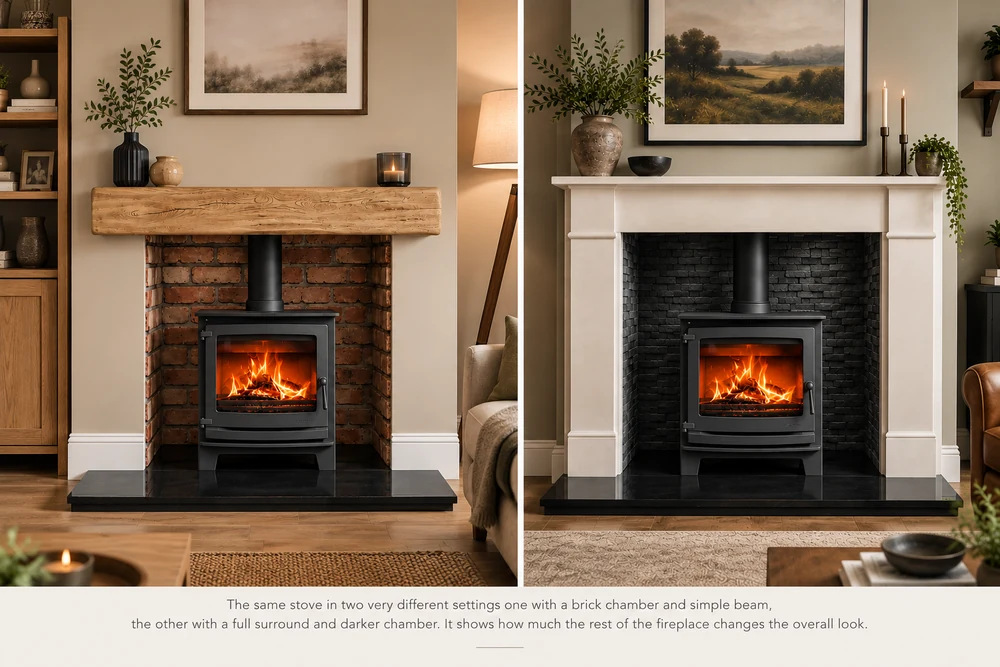
A simple glass-fronted stove with a limestone mantel, polished black granite hearth and a slate chamber is another combination I really like. Again, there is a mixture going on. The limestone creates a proper fireplace and gives the chimney breast some presence, while the polished granite and slate keep everything clean around the stove. Then the simple glass door brings your attention back to the fire.
You don’t need every component to belong to exactly the same style. This is why I would never choose the stove completely on its own — you need to look at the complete fireplace.
Traditional stoves obviously work well with brick chambers, wooden beams, stone surrounds and other more traditional fireplace materials. But one situation where I particularly like them is freestanding. If you have a stove sitting where you can properly see the legs, body and shape of the appliance, those traditional details become much more noticeable.
A stove with shaped legs, an arched door or a skirted base has enough character to stand on its own without relying on the fireplace around it. That doesn’t mean a traditional stove can’t sit inside a chamber — plenty do — but freestanding installations are a good opportunity to make more of the actual stove design.
The stove is only one part of the fireplace. Put the same stove into a red brick chamber and then put it into a smooth slate chamber and you can end up with two very different-looking installations. The hearth has an effect too.
A clean polished granite hearth can sharpen the appearance of a fireplace, while slate tends to give a softer, more natural finish. Rather than trying to decide whether every individual component is traditional or contemporary, I prefer to look at how everything blends together.
We have covered this in more detail in our guide to brick or slate fireplace chambers.
If a customer tells me they like a stove but aren’t sure whether it will suit their fireplace, I don’t just look at the stove.
I want to see the rest of the room — the furniture, where the television sits, the type of hearth and chamber, whether there is a beam or full mantel, and the colours and materials already being used.
All of those things have more influence on the finished result than simply saying a property is old or modern.
Not as often as you might think. Most customers already have a fairly good idea of the style they prefer before they come in.
If somebody likes traditional stoves, they normally continue to be drawn towards traditional stoves. Likewise, somebody who likes the clean appearance of a stove with a large viewing window will usually keep coming back to that style.
Where the showroom really helps is seeing how the stove looks as part of a complete fireplace. A stove that looks one way on its own can feel completely different once you see it with the right chamber, hearth and surround.
Personally, I lean towards contemporary stoves. A large viewing area, thin frame and simple design is what I prefer, even in an old property. My own house proves that.
But that doesn’t mean I think contemporary is better. If you love the appearance of a two-door stove with shaped legs and more traditional detailing, that is probably the direction you should go. The main thing is not to choose a stove because you think it is what your house is supposed to have.
Choose the style you like, then look at the chamber, hearth, beam or surround around it and make the whole fireplace work together.
If you would rather see complete combinations instead of choosing every component separately, take a look at our Stove Packages, where the stove, hearth, chamber and surround or beam have already been paired together.
Phone
01773 718718
Email
sales@castfireplaces.co.uk