No products in the basket.
Once you’ve chosen your fireplace or stove and booked a fitter, there are a few things worth checking before installation day. Most experienced fitters can arrange things such as removing an old fireplace and organising a chimney sweep. If an existing gas appliance needs disconnecting, this should also be discussed and arranged beforehand.
The important thing is making sure everyone knows what needs doing before the fitter turns up.
This sounds obvious, but it is probably the most important thing to check. Don’t book a fitter assuming your fireplace will arrive in time. Make sure the fireplace, hearth, stove or fire is physically at the property before installation day. Otherwise, you could have a fitter turn up with nothing to fit and a completely wasted day.
At Castfireplaces we have our own delivery service and arrange delivery ahead of the fitting date wherever possible. We also deal with access when we deliver. If a large fireplace needs unpacking to get it through a doorway, for example, we can normally sort that at the delivery stage.
Castfireplaces is a supply-only company, so customers arrange their own installation. We do have a list of approved fitters who we know and have used over the years, which can be helpful if you don’t already have somebody lined up. They don’t work for Castfireplaces, so you should discuss the work, costs, credentials and installation arrangements directly with the fitter you choose.
If you’re having a solid-fuel stove installed, using a HETAS Registered Installer is one route to having the installation self-certified for Building Regulations compliance. A carbon monoxide alarm will also form part of a compliant new or replacement solid-fuel appliance installation.
Give the fitter as much working room as you reasonably can. Stone fireplaces take up more space during installation than people sometimes expect. A limestone or marble mantel can arrive in large crates containing several heavy sections, and the fitter needs room to unpack and handle them safely. We’d recommend clearing as much of the area around the chimney breast as possible.
Move furniture out of the way and remove pictures, ornaments, lamps, rugs and anything fragile or valuable that could be damaged. It’s also worth making sure the route into the room is clear and thinking about parking for the fitter, particularly if tools and heavy equipment need carrying some distance.
Unless you’ve agreed it with the fitter beforehand, we’d normally leave removal of the existing fireplace to them. It is often easier for the person carrying out the new installation to remove the old fireplace because they can see how it has been fitted and what is behind it. There is another reason to be cautious in older properties. Some older building materials, boards, flues and insulation products can contain asbestos.
If there is anything suspicious behind an old fireplace, don’t start breaking it apart. Speak to the fitter and get appropriate advice before anything is disturbed.
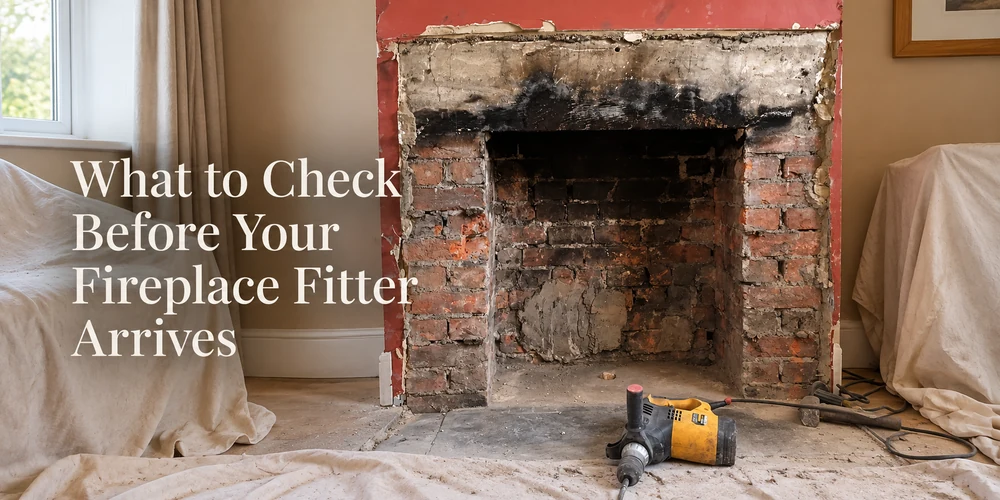
This is one of the biggest things we would recommend. If you think something might be an issue, mention it. We’ve had a customer who knew part of their chimney had previously been taken down upstairs to create more bedroom space. They then ordered a gas fire without mentioning it to us or the fitter until installation day. The obvious question then becomes: where are the fumes going to go?
That’s exactly the sort of information an installer needs before arriving at the property. If a chimney has been altered, partially removed, blocked, rebuilt or has had previous problems, tell the fitter. Don’t assume it won’t matter. The same applies to anything unusual you’ve discovered around the fireplace opening or chimney breast.
Most experienced stove fitters will arrange chimney sweeping, removal of the old fireplace and other preparation themselves, or tell you what needs doing before they arrive. Just make sure you’ve actually discussed it.
If you’re changing from a gas fire to a solid-fuel stove, we normally advise having redundant gas pipework removed from the chimney breast area rather than leaving it behind where the new installation needs to go. Any work on the gas supply needs to be carried out by an appropriately Gas Safe registered engineer.
This happens more often than you might think. Customers choose an electric fireplace, get everything else ready and then realise there isn’t a socket anywhere near it. You don’t want to finish a new fireplace installation with a trailing extension lead running across the room.
Work out where the electrical supply is going before the fireplace is fitted. If you’re replastering or decorating the chimney breast or wall at the same time, sort the socket position first rather than trying to add it afterwards.
Before fitting day, make sure the fireplace you’ve ordered is suitable for the space you’ve got. You don’t necessarily need to start taking technical measurements yourself if the installer has already surveyed the job, but any concerns over opening size, hearth position or available wall space are better raised beforehand. For heavy stoves and stone fireplaces, the fitter also needs to consider whether the hearth and supporting structure are suitable for the load.
Again, this is something to discuss with the installer rather than trying to assess yourself.
A few days before the fitter is due, check:
The main thing is not to keep information back because you aren’t sure whether it’s important. If you think something might affect the job, tell the fitter. It’s much easier to deal with a potential problem beforehand than discover it on installation day.
Phone
01773 718718
Email
sales@castfireplaces.co.uk