No products in the basket.
If you have an older Gallery cast iron fireplace, you may eventually notice that the firebrick at the back of the fireplace has started to bulge forwards. This is quite common with cast iron firebricks. Unlike a traditional clay or refractory firebrick, these are made from cast iron and are exposed to high temperatures every time the fireplace is used. Over many years, repeated heating and cooling can cause the casting to gradually distort.
So, when does a bulging firebrick need replacing?
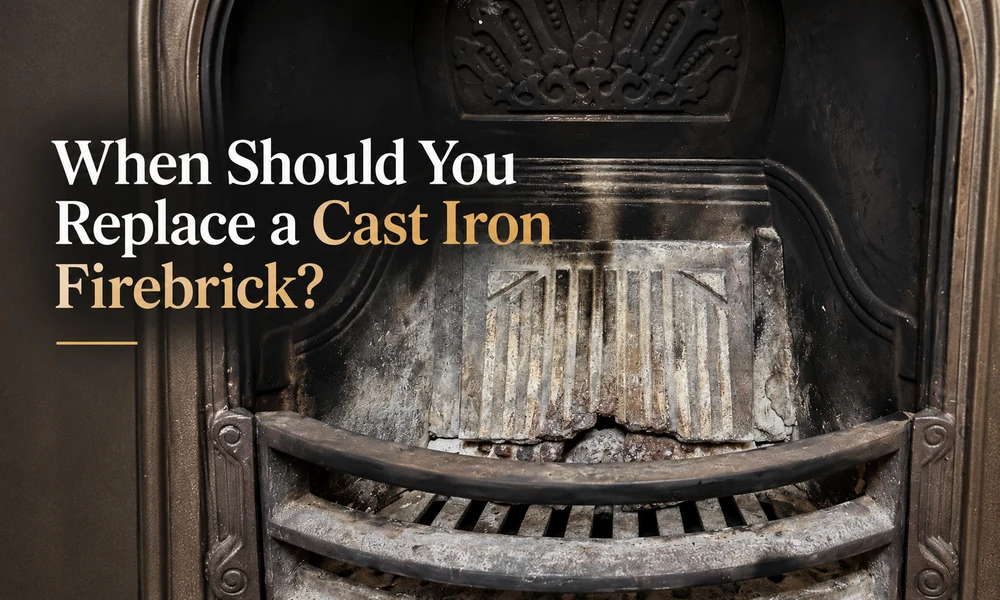
Cast iron expands when it gets hot. As the firebrick is repeatedly heated and cooled, the constant changes in temperature put stress through the casting. Over time, this can cause the firebrick to bow or bulge towards the fire. You may initially notice only a small amount of movement. On an older fireplace, however, the distortion can become more pronounced and the centre of the firebrick can move noticeably further into the firebox.
This is a natural consequence of the firebrick being exposed to high temperatures over a long period of time.
The simplest way to check is to inspect the firebrick when the fireplace is completely cold.
A small amount of distortion does not necessarily mean that it needs replacing. If the firebrick is still sound and the shape has only changed slightly, it may continue to give good service.
It is worth considering replacement when:
The main thing to look for is significant distortion rather than simply the age of the firebrick.
There isn’t a set replacement period. The lifespan will depend on how often the fireplace is used and the amount of heat the firebrick is subjected to. A fireplace that has been used regularly for many years will naturally put more thermal stress through the casting than one that has only been used occasionally. For this reason, it is better to check the condition of the firebrick rather than replace it simply because it has reached a particular age.
A degree of distortion is to be expected with an older cast iron firebrick. The important point is how far it has moved from its original shape. If it has become heavily bowed into the firebox, is cracked or broken, or is no longer fitting as it should, replacing it is sensible.
If you are unsure about the condition of your fireplace, particularly if it is used for solid fuel, it is best to have it checked by a suitably qualified professional.
Replacement cast iron firebricks are available for a number of our fireplaces, but they are not all the same size. It is important to identify the model of your fireplace before ordering so that you get the correct firebrick. While replacing the firebrick, it is also worth checking the retaining slides and screws that hold it in position. These are exposed to the same heat and can become worn or deteriorated over time. Replacement slides and screws are available if required.
A new firebrick restores the back of the firebox to its original shape, replacing the casting that has gradually distorted through years of use.
There is no need to replace a cast iron firebrick simply because it has been used for a certain number of years. Instead, check its condition from time to time, particularly if you have an older fireplace that is used regularly. If you notice that the firebrick has developed a significant bulge into the firebox, or it has cracked, broken or become difficult to fit correctly, it may be time for a replacement.
We supply replacement cast iron firebricks for our range of fireplaces, with different sizes available to suit the individual models.
Phone
01773 718718
Email
sales@castfireplaces.co.uk