No products in the basket.
Bioethanol fireplaces have become increasingly popular over recent years, and for good reason. They give you a real flame without the need for a working chimney, making them a flexible option for both traditional and modern homes. At Cast Fireplaces, we have carefully selected our range of bioethanol fireplaces and matched the individual components into complete packages. We have chosen combinations that we believe work well together, rather than simply offering a collection of products. You can see our full range of bioethanol fireplaces here.
But which type of bioethanol fireplace is right for your home?
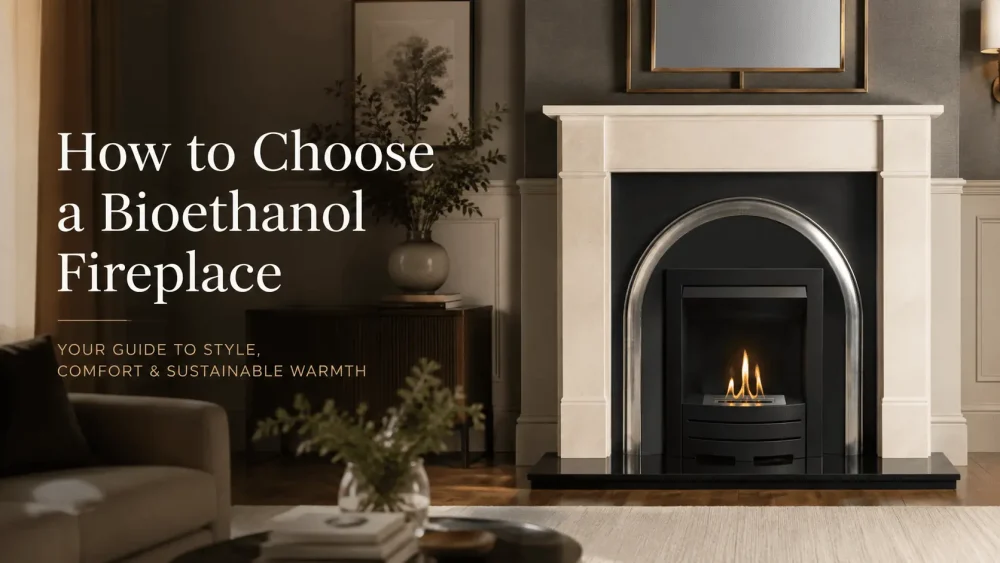
One of the main reasons people choose bioethanol is that you get a genuine flame rather than an imitation flame effect. When first lit, the fire takes a little time to warm up and develop into an established flame. Once it is burning properly, the effect is very different from an electric flame. Depending on the burner being used, the fire can also be controlled by reducing the burner opening. It is difficult to appreciate the effect fully from a photograph. If the appearance of the flame is important to you, I would always recommend seeing a bioethanol fire burning if you can.
This is one of the first decisions to make.
If you have a chimney breast and want the appearance of a traditional fireplace, there are some excellent options in marble, limestone, cast iron and wood. There is one important point to remember. With a traditional fireplace, you need to consider what is going inside the chimney breast as well as what you see on the outside. The insert and burner need to fit correctly within the available recess. One of the mistakes we see is customers choosing a traditional fireplace based purely on how it looks, without considering the space required behind the surround. If you already have an existing fireplace that you want to keep rather than replacing it with a complete package, have a look at our guide to converting an existing fireplace to bioethanol.
Flat-wall bioethanol fireplaces are a good option where you don’t have a traditional chimney breast or fireplace opening. Installation is generally straightforward, with the skirting board normally needing to be removed behind the fireplace so that it can sit correctly against the wall. What I particularly like about our flat-wall range is that they don’t look like inexpensive, mass-produced fireplace furniture. We have deliberately chosen premium materials so that the finished fireplace has the appearance you would expect from a proper fireplace, even when it is fitted against a flat wall.
Once you know whether you need a traditional or flat-wall fireplace, the next thing to consider is size. A surround that is too large can dominate a smaller room, while a fireplace that is too small can look lost on a large chimney breast or wall.
Measure:
The internal measurements are particularly important because the insert and bioethanol burner need enough space within the fireplace opening. Don’t assume that a fireplace will work simply because the overall surround width looks right.
You don’t have the same recess restrictions, but proportion is still important. Consider the overall width of the wall and how the fireplace will sit alongside other features in the room, such as furniture, televisions, shelving and doorways.
Once you’ve established the type and size of fireplace you need, you can concentrate on how you want it to look. The surround is a major part of the finished appearance, so I wouldn’t choose the material simply on price.
Personally, I have always loved marble. There is something about a marble fireplace that is difficult to reproduce with anything else. The veining, colour variations and timeless appearance mean that a good marble surround can look just as right many years from now as it does when it is first installed.
It works particularly well if you want the fireplace to feel like a main feature within the room.
Limestone gives a softer and more understated appearance. It works particularly well where you want a traditional fireplace without the stronger veining and pattern that you often get with marble. Its lighter, more natural appearance also makes it easy to use in both traditional and more contemporary interiors.
Cast iron is an excellent choice if you want a stronger period appearance. It works particularly well in Victorian-style rooms and with traditional fireplace designs where you want the insert itself to become an important part of the overall look.
A wooden surround can give a warmer and more relaxed appearance. It can work particularly well in cottage, country and more informal interiors where marble or limestone may feel a little too formal. There isn’t necessarily a right or wrong material. The important thing is choosing something that works with the room, the property and the style you want to create.
| Your situation | What I’d consider |
|---|---|
| You have a traditional chimney breast | A traditional fireplace with a suitable bioethanol burner |
| You have an existing fireplace you want to keep | Consider whether it could be converted using a suitable bioethanol burner |
| You have a modern home with a flat wall | A premium flat-wall bioethanol fireplace |
| You want a timeless luxury finish | Personally, I’d look closely at marble |
| You want a softer, understated traditional look | Limestone is an excellent choice |
| You want a period-style fireplace | Cast iron works particularly well |
| You want a warmer, more relaxed appearance | A wooden surround can work very well |
| You’re unsure which size to choose | Start with the room measurements and fireplace opening rather than choosing by appearance alone |
Choosing the right bioethanol fireplace is mainly about finding the right combination of style, size and installation type for your room. If you are fitting a traditional fireplace, the available opening and depth will determine which inserts and burners will work. With a flat-wall fireplace, the main consideration is choosing a size and style that looks properly proportioned within the room. If you’re still deciding whether bioethanol itself is right for you, our guide Are Bioethanol Fireplaces Any Good? covers how they work, their advantages and some of the practical points to consider before buying one.
As with any real-flame appliance, always follow the manufacturer’s instructions for installation, use and refilling.
If you’re unsure which fireplace will work in your home, send us a photograph of the room along with a few rough measurements and we can help you narrow down the options.
Phone
01773 718718
Email
sales@castfireplaces.co.uk