No products in the basket.
Buying a new fireplace or stove is one thing, but who should actually fit it?
This is something we’re often asked at Cast Fireplaces. The answer depends on the type of fireplace you’re buying and whether you’re using solid fuel, gas, electric or bioethanol.
Some installations must involve a suitably registered professional, while others can be fairly straightforward for somebody confident with DIY. Here’s what we’d recommend.
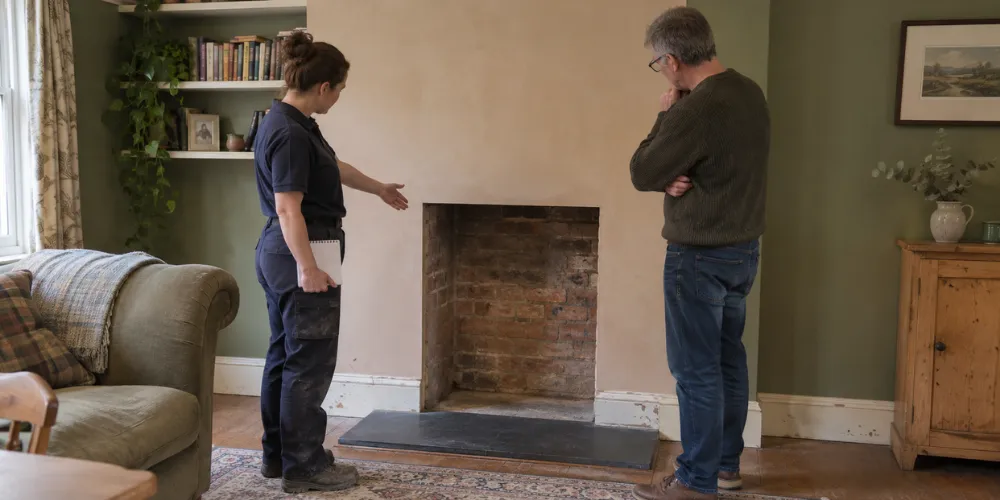
For any wood-burning or multi-fuel stove installation, our advice is to use a HETAS-registered installer who is registered for the work being carried out. A stove isn’t simply a case of putting it into a fireplace and connecting a flue. The installer needs to consider the chimney, ventilation, hearth, clearances and the requirements of Building Regulations. In England and Wales, new solid-fuel installations must be notified to Building Control. A suitably registered installer can self-certify the work through an approved competent person scheme such as HETAS.
It is possible to use an installer who isn’t registered with such a scheme, or to carry out the work yourself, but you would need to arrange the appropriate Building Control approval before starting.
We would always recommend the registered installer route. It’s generally simpler and gives you somebody experienced in fitting stoves correctly.
You can browse our wood-burning and multi-fuel stoves before discussing the installation with your fitter.
This one is straightforward. Gas fire installation and gas work must be carried out by a Gas Safe registered engineer qualified for the type of appliance being installed. That includes connecting a new gas fire or disconnecting an existing one. Not every Gas Safe engineer is qualified to work on every gas appliance, so always check that they’re registered for gas fires. They will also need to check that the fireplace, ventilation and any required chimney or flue arrangement are suitable.
If you’re replacing an existing gas fire with an electric or bioethanol model, remember that any gas disconnection must still be carried out by an appropriately registered engineer.
In many cases, yes. Electric fires can be considerably easier to install because they don’t require a working chimney or flue. Many models simply plug into a suitable socket, so a competent DIYer may be able to fit the fire and surround themselves, provided they follow the manufacturer’s instructions.
However, this depends on the type of electric fire.
A larger inset fire, media wall installation or fireplace requiring alterations to the wall may be better handled by an experienced fitter. If the installation involves new electrical wiring, moving sockets or hardwiring the fire, we’d recommend using a qualified electrician. Any electrical work must meet the relevant regulations.
You can see our range of electric fires, including inset fires and media wall models.
Many bioethanol fireplaces can also be fitted by a competent DIYer. These fires don’t require a gas connection or chimney, which makes installation much simpler in many homes. However, not every bioethanol fireplace is fitted in the same way. Some are suitable for flat walls, while others are designed to sit inside a traditional fireplace opening. Wall-mounted and inset models must be installed exactly as the manufacturer specifies. Even though there’s no chimney involved, bioethanol produces a real flame. Suitable ventilation, safe positioning and the correct distances from combustible materials are important.
For a straightforward installation, competent DIY may be suitable. For heavier or more complicated fireplace packages, we’d recommend using a fitter.
Have a look at our bioethanol fireplaces or flat-wall fireplace packages to see the different options.
It’s worth remembering that fitting the fire and fitting the fireplace surround aren’t always the same job. For example, a competent DIYer may be comfortable installing a wooden surround with an electric fire. A large limestone or marble fireplace is a different matter. These surrounds can be extremely heavy, often arriving in several sections that must be correctly positioned, supported and securely fixed. The same applies to traditional cast iron fireplaces, particularly those being installed for solid fuel.
We’d generally recommend having these fitted professionally, regardless of whether you’re using gas, electric, bioethanol or solid fuel.
Yes, in some areas we can. Cast Fireplaces is a supply-only company, so we don’t carry out installations ourselves. However, we have independent fitters we can recommend in certain parts of the country. We always recommend using an experienced professional, particularly for heavier fireplace packages and solid-fuel installations. Any recommended fitter works independently of Cast Fireplaces, so you’ll need to arrange the work, costs and installation details directly with them.
You can check our recommended fireplace fitters to see whether we have somebody covering your area.
We’d always suggest finding a fitter before ordering your fireplace or stove, particularly if you’re unsure about your chimney opening, hearth or the space available. They can advise you on what’s suitable for your property and whether any preparation is needed before the fireplace arrives.
Once you’ve arranged your installation, have a read of our guide on what to check before your fireplace fitter arrives.
And if you’re unsure about the dimensions or fitting requirements of one of our fireplaces, you’re welcome to contact us at Cast Fireplaces. We’re always happy to explain the products we sell and help you work out what information your fitter will need.
Phone
01773 718718
Email
sales@castfireplaces.co.uk