No products in the basket.
If you’ve seen the recent headlines about wood-burning stoves, you could be forgiven for thinking that owning one is about to become illegal. We’ve seen claims about wood burners being “banned”, homeowners facing huge fines and existing stoves becoming unusable.
But that’s not an accurate description of the current position.
Wood burners aren’t simply being banned.
What is happening is that the rules around domestic burning are becoming tighter, particularly around emissions, fuels and the standards that new appliances must meet. We’ve been in the fireplace and stove industry for years, and we’ve seen these changes happen before. The important thing is to understand what the rules actually say rather than relying on the headline.
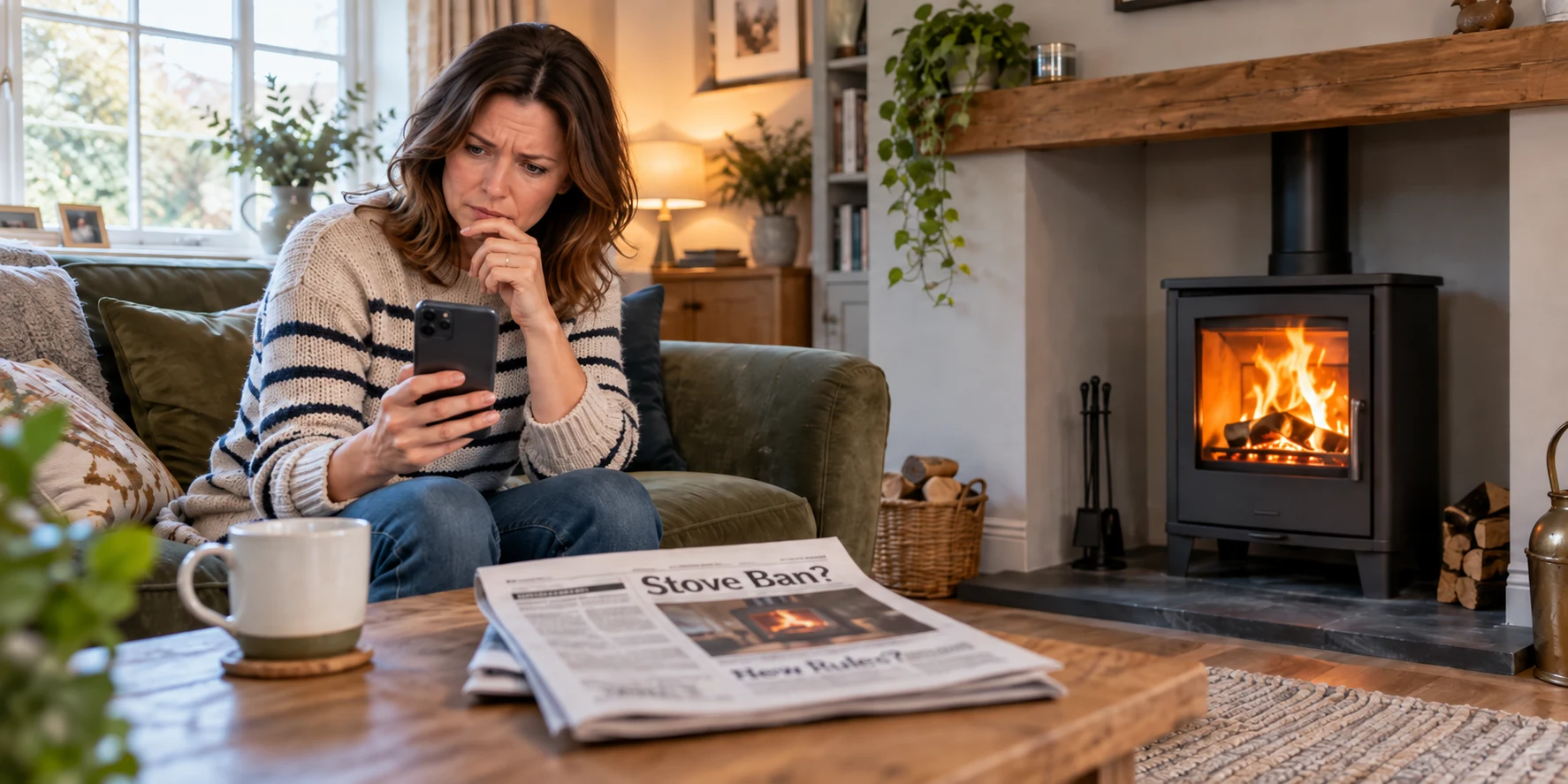
No general ban on domestic burning is currently being proposed in England.
The Government has previously stated that it is not considering a ban on domestic burning in England. At the same time, the Government is continuing to look at ways of reducing emissions from domestic solid-fuel burning. In January 2026, Defra launched a consultation proposing measures including tighter emission limits for new stoves, labelling requirements for stoves and fuels, and increased penalties for certain breaches.
That is a tightening of standards. It is not the same thing as announcing that wood-burning stoves are being banned.
There are several different issues being discussed at the same time.
These include:
Put all of those subjects together in one headline and it is very easy to create the impression that the Government is banning wood burners. The reality is considerably more specific.
Some of the confusion comes from rules that have already been introduced around the fuels people burn. Traditional house coal can no longer legally be sold for domestic use in England, and restrictions also apply to the sale of wet wood. Those are fuel restrictions rather than a ban on wood-burning stoves.
We’ve covered these rules separately in our guide to Coal and Wet Wood Rules: What Has Changed for Wood-Burning Stoves?
This is where things have changed significantly for the stove industry. Modern appliances have to meet increasingly demanding emissions and efficiency requirements.
Ecodesign requirements have already changed the market for new solid-fuel appliances, and the industry has adapted. Manufacturers have had to test and develop their appliances to meet the required standards, and some older or less popular models disappeared from the market as a result.
We’ve seen this ourselves.
For a period, certain larger-output and double-sided stove models became much harder to find. As manufacturers developed compliant models, many of those options began returning to the market. That’s an important point.
When the rules change, the industry adapts. It doesn’t automatically mean the end of the product.
This is one of the questions we are asked most often. If you already have a stove, don’t read a headline about future emissions standards and assume that you have to remove it. There is no blanket Government requirement currently saying that every existing legally installed wood-burning stove has to be removed simply because newer standards are introduced. There are, however, rules that can apply to how an appliance is used, particularly in Smoke Control Areas and depending on the fuel being burned.
So if you have an existing stove, the sensible thing is to understand the rules applying to your appliance, your location and the fuel you are using.
This is another area where headlines can cause confusion. In Smoke Control Areas, there are restrictions on releasing smoke from a chimney and on the fuels that can be used. Government guidance currently states that, in England, a penalty of up to £300 may apply where smoke is released from a chimney in a Smoke Control Area. It also states that a fine of up to £1,000 can apply for buying unauthorised fuel to use in an appliance that is not approved by Defra.
Those are specific offences.
They do not mean that every wood-burning stove owner is suddenly facing a £5,000 fine.
This is where it is particularly important to read beyond the headline. The Government’s 2026 consultation proposed increasing penalties for non-compliance with existing regulations. But a consultation proposal is not the same thing as a new law already applying to every homeowner.
So when you see a headline saying that wood-burning stove owners face a £5,000 fine, look at exactly what offence the article is referring to, whether it relates to a proposal or existing legislation, and whether it applies to your circumstances. The headline alone doesn’t tell you that.
Our advice is straightforward. If you’re buying a new stove today, choose a modern appliance that meets the current applicable requirements and buy it from an established manufacturer and reputable stove retailer.
You can view our range of wood-burning and multi-fuel stoves to see the current models available. At Cast Fireplaces, we sell hundreds of stove models, with more than 80 models on display in our showroom.
All of the new wood-burning and multi-fuel stoves we sell meet the current Ecodesign requirements applicable to them.
That gives customers a much easier starting point than trying to work out whether an older model found on the second-hand market is still suitable for a new installation. If you’re still deciding on the right stove and fireplace combination, our guide to How to Choose a Stove Package explains some of the things worth considering before you buy.
This is one area where we would urge homeowners to do their homework. There are plenty of older stoves available through private sales and refurbishment businesses. Some may look almost identical to a current model.
That doesn’t necessarily mean they have the same approvals, testing or emissions performance.
If you’re buying a stove for a new installation, we’d strongly recommend checking the exact model, its current certification and the requirements applying to the installation before handing over your money. A cheap stove isn’t necessarily a cheap stove if you later discover it isn’t suitable for your installation.
The important thing to understand is that tighter standards aren’t new to this industry. Previous changes have resulted in manufacturers testing, redesigning and replacing models.
Some products disappeared. Others were introduced.
And some categories that became difficult to source — including larger and double-sided appliances — have subsequently returned as compliant models became available.
That’s how regulation normally works. The industry adapts to the standards.
If you’ve seen the recent headlines and are now wondering whether you should cancel plans for a new stove, don’t make that decision based on a headline alone. The current picture is much more straightforward:
Wood burners aren’t being banned.
Fuel rules have tightened.
New stove standards have tightened.
Emissions are under increasing scrutiny.
Smoke Control Area rules still matter.
And further changes may follow from the Government’s 2026 consultation.
For anyone buying a new stove, the sensible approach is to choose a modern, compliant appliance from a reputable manufacturer and supplier. That’s exactly why we keep a large range of current models on display at Cast Fireplaces. The rules may continue to evolve. The stove industry will continue to adapt.
And modern wood-burning stoves remain very much part of the market.
The headlines may be dramatic. The actual rules are more complicated — and that’s what homeowners need to understand.
Phone
01773 718718
Email
sales@castfireplaces.co.uk